North Florida water and utilities authority
Concerned Citizens of North FL - Empowering Communities
9/5/26 Update
County hopes to negotiate NFWUA changes with Suwannee
By JAMIE WACHTER on Saturday, September 5, 2026
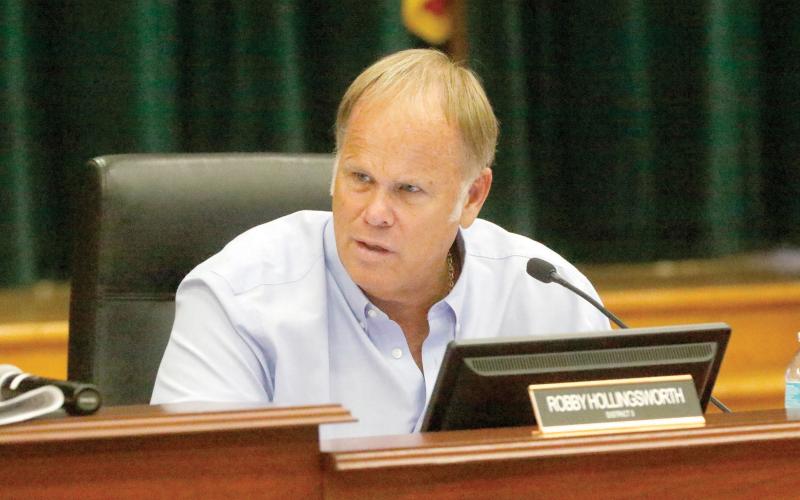 Columbia County Commissioner Robby Hollingsworth moved to negotiatte with Suwannee County on the utility partnership. (JAMIE WACHTER/Lake City Reporter)
Columbia County isn’t going to pull out of a regional utility partnership after all.
Following the advice of County Attorney Joel Foreman, the Columbia County Commission voted unanimously Thursday night to try to negotiate through concerns about the North Florida Water Utilities Authority with its partner Suwannee County. Those negotiations will be done, on Columbia County’s behalf, by Chairman Tim Murphy, Foreman, County Manager David Kraus and Assistant County Manager Kevin Kirby.
“I just want to get it back going, I think that water authority is important and I think we got in a bad area with it,” Commissioner Robby Hollingsworth said in making the motion to go into negotiations.
Hollingsworth voted in August to request Suwannee County replace its elected officials on the NFWUA governing board or for Columbia County to move forward with dissolving the authority.
Foreman, though, told the commission that it couldn’t dissolve the NFWUA but could withdraw with a 180-day notice. But in a risk analysis memo to the commission, Foreman recommended not taking that route since an interlocal agreement last year handed over operations and maintenance of the county’s utility assets through 2030 to the authority. Foreman said that would also need to be funded by the county, which currently comes at approximately $520,000 annually.
“I did not feel strong about our prospects of success in that litigation,” Foreman said if the country tried to not fund the utility cost if it chose to withdraw from the authority.
The other option the board has other than negotiating potential changes to the agreement, would be the status quo. However, with concerns already aired about the composition of the board, Foreman said he believed there would be future issues as well.
Foreman also told the commission on Thursday that Suwannee County Attorney Adam Morrison expressed optimism that the Suwannee County Commission would be willing to negotiate.
The Columbia County board, following discussion Thursday, added that it desires those negotiation meetings to be public meetings.
“Everybody wants transparency, I want transparency, the public wants transparency,” Commissioner Rocky Ford said. “I think this should be in the public eye.”
RATES INCREASED
During Thursday’s meeting, the board also unanimously approved raising utility rates. Those rate increases will have to be finalized with another vote of the board, which Foreman said may be two months away.
While the NFWUA board recommended — following a rate study and one reduction already — increases that ranged from 11% for commercial wastewater users in Ellisville to 65% for those same water users on county-owned utilities, the commission didn’t go with those recommendations. Residential water users in Ellisville and Mason City were facing a 33% increase.
Foreman noted that the county had not increased its rates since beginning utilities in Ellisville about 17-18 years ago.
Rather, the board voted for 10% increases to all the rates.
“It’s not fair to the public,” Murphy said, noting that the rates determined by Raftelis for the NFWUA were done so in an effort to bring in $1 million in revenue. “I’m going to call it neglect on Columbia County’s part for not addressing this issue at an earlier time (increasing rates).”
The NFWUA’s proposed budget is based on those rate increases as well as subsidies from both the counties of $520,000. Suwannee County approved its recommended rates Tuesday.
9/2/26 Update
Columbia County Attorney: Don’t just withdraw from utility
By JAMIE WACHTER on Tuesday, September 1, 2026
Foreman recommends county negotiates changes with Suwannee.
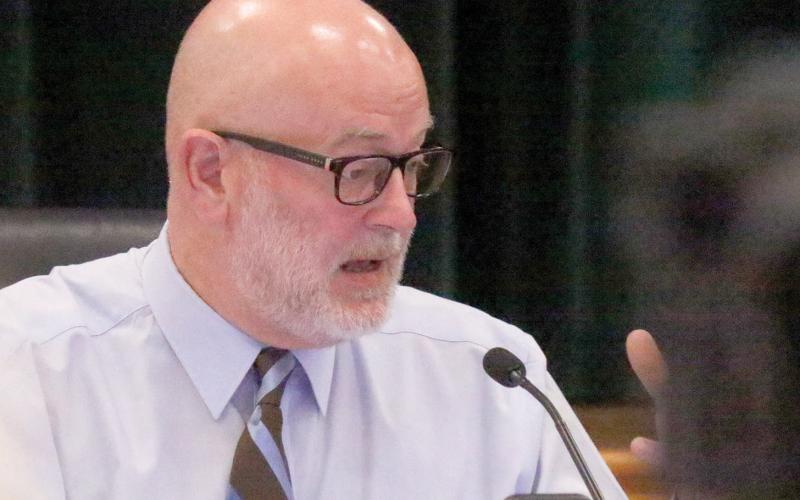 Columbia County Attorney Joel Foreman is recommending the County Commission attempt to negotiate with its Suwannee County counterparts about the North Florida Water Utilities Authority instead of moving to withdraw from the partnership entirely. (FILE)
Columbia County shouldn’t proceed with previous stated plans to withdraw from the North Florida Water Utilities Authority according to its attorney.
In a memo to the County Commission, as well as County Manager David Kraus and Assistant County Manager Kevin Kirby, on Thursday, County Attorney Joel Foreman provided three options to the county on how it should proceed with plans relating to the utility partnership with Suwannee County: withdrawing as the commission threatened to due on Aug. 6, change nothing or negotiate changes in the oversight of the NFWUA with its counterparts in Suwannee County.
Of those options, Foreman said negotiating is the best path forward. Foreman will present his recommendation, which is based on a pair of interlocal agreements that established the NFWUA and turned over the operations and maintenance of all the utility plants the two counties own, to the board at its 5:30 p.m. meeting Thursday at the Keith Hudson School Board Auditorium, 372 W. Duval Street in Lake City.
“As the case with any other business relationship, agreements can and frequently should be renegotiated,” Foreman wrote in the memo. “Given the Board’s expressed concerns about the operation of the Authority, presenting those concerns to Suwannee County through a negotiating team would seem the best mechanism for addressing the Board’s concerns and potentially securing changes to the agreements which will better suit the purposes of all concerned.”
At its Aug. 6 meeting, the Columbia County Commission voted 4-1 to issue an ultimatum to Suwannee County about the composition of the NFWUA governing board, which has two appointees each from the two counties as well as an at-large member appointed by the NFWUA board. It began with two commissioners from each county but Columbia County moved in July to replace its two elected officials.
Suwannee County, though, opted to keep its elected officials in place as long as it still owned the utility facilities. Columbia County Commissioner Robby Hollingsworth made the motion to ask Suwannee County to reconsider that belief within 30 days or move to dissolve from the partnership over concerns of politics interfering with the operations of the NFWUA.
However, in that Aug. 6 meeting, Foreman told the board that it couldn’t just dissolve the NFWUA. A dissolution of the authority requires action by both member counties. Rather, one county could move to withdraw with a 180-day notice given.
Suwannee County responded with a unanimous vote to reject that request at its Aug. 18 meeting, sending a letter back to Columbia County that said it plans to move forward with the status quo and would take good care of Columbia County’s utility assets if the county still chose to pull out of the partnership.
In his memo to the commission, Foreman advised the board that if it chooses to withdraw from the NFWUA, it opens itself to the “very high” likelihood of legal action.
While the 2024 interlocal agreement between the two counties to create the NFWUA allows either side the option to withdraw with a 180-day notice, the subsequent agreement in 2025 gave the Authority the right to operate and maintain the utility plays through September 2030, including funding from the member counties.
Foreman said the letter the county received from Suwannee County Chairman Franklin White suggests that the NFWUA and Suwannee County would likely seek to enforce that agreement, including likely legal action if the county stopped funding the utility operation at a cost of likely more than $2 million — the cost of the county’s obligation over the course of the remaining four years of the agreement.
“Because withdrawal would result in the Board losing representation on the Authority board, and because there is a high probability that the Authority and Suwannee County will seek to enforce the second agreement against the County with likely success in those efforts, this course is not recommended,” Foreman wrote in the memo.
The other option is to ignore its previous statement of intent to pull out of the partnership and continue to take part in the Authority as is.
That, though, also has a problem, according to Foreman.
“Because the status quo as existed prior to this dispute resulted in an erosion of the Board’s confidence in the Authority, a no-action approach is not recommended,” he wrote. “The risk will remain high that discord among the counties and Authority will continue.”

North Florida water and utilities authority
Concerned Citizens of North FL - Empowering Communities
08/26/26 Update
NFWUA meeting doesn’t address counties’ feud
By JAMIE WACHTER on Tuesday, August 25, 2026
Attorney: ‘I assume they will resolve whatever differences.’
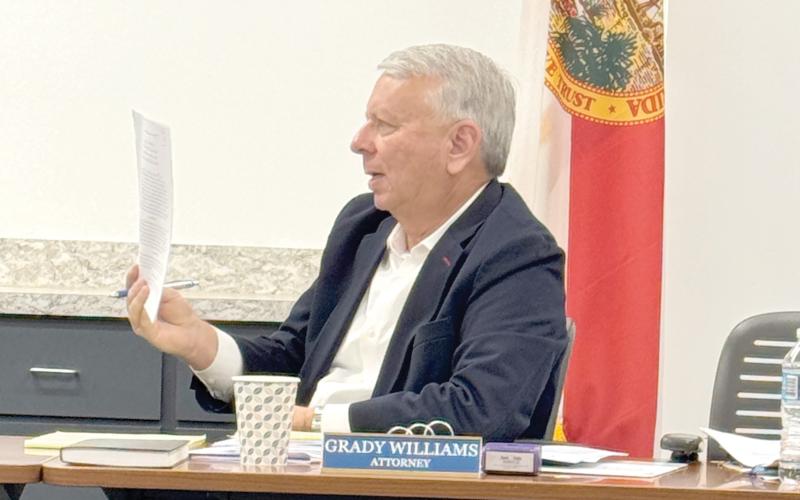 North Florida Water Utilities Authority Attorney Grady Williams holds up a copy of the 2025 interlocal agreement between the authority and both Columbia and Suwannee counties about operation and transfer of the utility assets in both counties. (JAMIE WACHTER/Lake City Reporter)
After asking a multitude of questions to “trying to get my ahead around” the business of the North Florida Water Utilities Authority, Jock Phelps asked one more as the meeting wound down Monday morning.
It was the question most were wondering: What to make of the threats of a split between the Columbia County Commission and its Suwannee County counterparts over the composition of the utility board?
“It affects this board,” Phelps said near the end of the nearly two-hour long meeting in Lake City. “It needs to be addressed.”
However, NFWUA Chairman Franklin White, a Suwannee County commissioner, and NFWUA Attorney Grady Williams said it wasn’t a topic of the board. Williams said there were not outstanding motions by the NFWUA board.
Williams added, although he also agreed with Phelps that it does impact the fledgling utility authority board.
“I assume (the two county commissions) will resolve whatever differences they have,” Williams said.
On Aug. 6, the Columbia County Commission voted 4-1 to request that Suwannee County appoint non-elected officials to serve on the utility board like Columbia County already had in order to remove politics from the utility operations. If Suwannee County didn’t do that within 30 days, Columbia County would begin the process of withdrawing from the NFWUA.
The Suwannee County Commission replied last week with a unanimous vote to respond with a no.
According to the 2024 interlocal agreement that established the NFWUA, if one county chooses to withdraw, there is a 180-day notice to allow for the transition of services in order to do so.
That interlocal is still in effect, according to Willliams and NFWUA Executive Director Shannon Roberts.
In its response, Suwannee County, though, said a 2025 interlocal between the two counties and the utility authority on transferring utility assets gave the NFWUA control of operations over both sets of utility facilities through 2030.
There was no answer Monday as to that interpretation.
However, Williams did say there will be more clarity provided ahead of the NFWUA’s September meeting as to what its future looks like.
“I hate to state the obvious but we’ve been talking a lot about the budget cycle and the rates,” he said. “To my simple mind, we’ll know a lot about what’s going on in Fiscal Year 2026-2027 when we adopt our final budget and our final rates.”
Phelps, who was sworn onto the NFWUA board at the start of Monday’s meeting after being appointed in July by the Columbia County Commission, was thorough in questions for Roberts, Williams and NFWUA financial consultant Richard Powell on expenses and other operations of the NFWUA.
“I want to see this board successful,” Phelps said. “I think the Authority has a purpose. I’m just not sure what it is now and I’m trying to get my head around it.”
Walt Graham, the other person the Columbia County Commission appointed to serve on the board, withdrew without taking office due to a conflict. Kraus said Monday that Columbia County is advertising for interest in the position once again and, hopefully, can make another appointment in September.
Utility board moves budget meeting
By JAMIE WACHTER on Tuesday, August 25, 2026
September meeting delayed so counties can finalize spending.
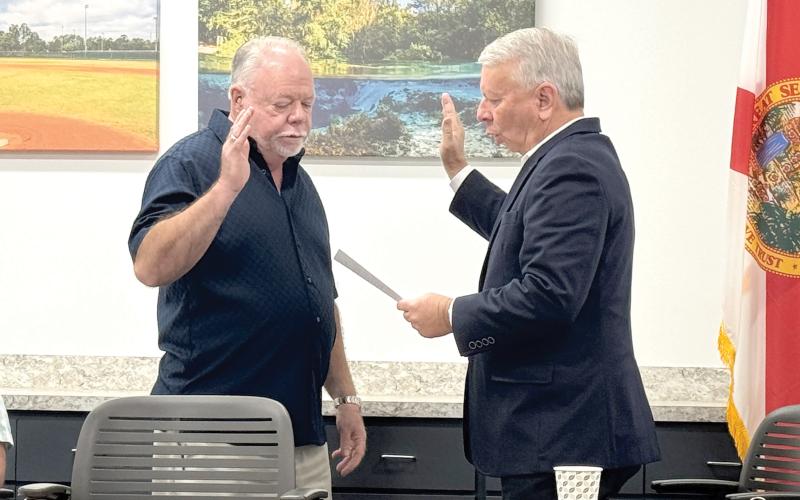 North Florida Utilities Authority board member Jock Phelps (left) is sworn in ahead of Monday’s meeting by NFWUA Attorney Grady Williams. Monday was Phelps’ first meeting as a member of the utility board. (JAMIE WACHTER/Lake City Reporter)
The North Florida Water Utilities Authority is moving its meeting next month a week in order to better finalize its budget.
During its meeting Monday morning, the NFWUA board agreed to delay its September meeting to Sept. 28 in order to allow both Columbia and Suwannee counties to finalize their budgets ahead of the utility board’s budget approval. The two counties, which partnered on the regional utility authority, subsidize the NFWUA. It has requested $520,000 from both counties for the upcoming fiscal year, the same amount it received this year.
Columbia County’s final budget hearing is set for Sept. 17, while Suwannee County’s final budget hearing is set for Sept. 21. The NFWUA original was scheduled to meet on Sept. 21 as well.
But that would have meant meeting ahead of Suwannee’s finalized budget since the NFWUA meets in the morning.
“We can’t do that,” Jock Phelps, the NFWUA’s newest board member, a Columbia County appointee who took his oath of office Monday, said about approving a budget without knowing what funding levels were approved by the two counties. “I’m speaking for myself as a board member, I wouldn’t feel comfortable doing that.”
Franklin White, the NFWUA’s new chairman and a Suwannee County commissioner, agreed.
NFWUA Executive Director Shannon Roberts had also requested the board consider moving the meeting in order to make sure it had a firm idea on what its funding would look like ahead of finalizing its budget.
“The thought is we’re not asking our board to approve something where they don’t understand if Suwannee County has gone through their budget, so we’re wanting to move this meeting back until after Suwannee County has met,” Roberts said.
Columbia County Commission Chairman Tim Murphy, who is also a former NFWUA board member, asked the utility board to consider amending its budgeting process moving forward. Murphy suggested that the NFWUA try to have its budget prepared in the future by June 1 — the date constitutional officers are required to have a budget submitted — in order to alleviate so many meetings and concerns late in the process.
“I think it would make lives a lot simpler,” Murphy said during public comment. “You’d be operating off like a 10-month operation this year, but I’d highly recommend that be business No. 1.
“That would solve a lot of these discussions here today.”
That upcoming budget meeting the only meeting date set by the NFWUA during its meeting Monday.
Rather the board went ahead and set its meeting dates for Fiscal Year 2026-27, which are still scheduled to be the third Monday of each month.
While the board discussed in June potentially moving its meetings from a 9:30 a.m. start time to 5:30 p.m., the board was split 2-2 on Monday on the start time. White and Leo Mobley, the other Suwannee County commissioner serving on the board, preferred the evening meetings while Phelps and Stephen Dicks, the at-large board member, wanted the morning meetings.
The meetings will remain at 9:30 a.m. until a fifth member is appointed by Columbia County in order to break the deadlock.
“I guess we’re going to have to wait on another board member,” White said.
The October and December 2026 meetings as well as the February, April, June and August 2027 meetings are scheduled to be in Lake City, while the November 2026 meeting and the January, March, May, July and September 2027 meetings are slated to be in Live Oak.
Roberts brought up potential conflicts to the board on three of the meeting dates: the November, December and January meetings.
According to Roberts, the Judicial Annex in Suwannee County is not available the Nov. 16 meeting date, while the December meeting falls the week of Christmas and the January meeting date falls on Martin Luther King Jr. Day.
The board decided to not change dates for the November or December meetings, instead finding a new location for the November meeting in Live Oak, whether it is at Live Oak City Hall or some other space that Suwannee County owns.
The January meeting was rescheduled for Jan. 25.
North Florida water and utilities authority
Concerned Citizens of North FL - Empowering Communities
08/20/26 Update
Suwannee Commissioners reject ultimatum on utility board appointments
By JAMIE WACHTER on Wednesday, August 19, 2026
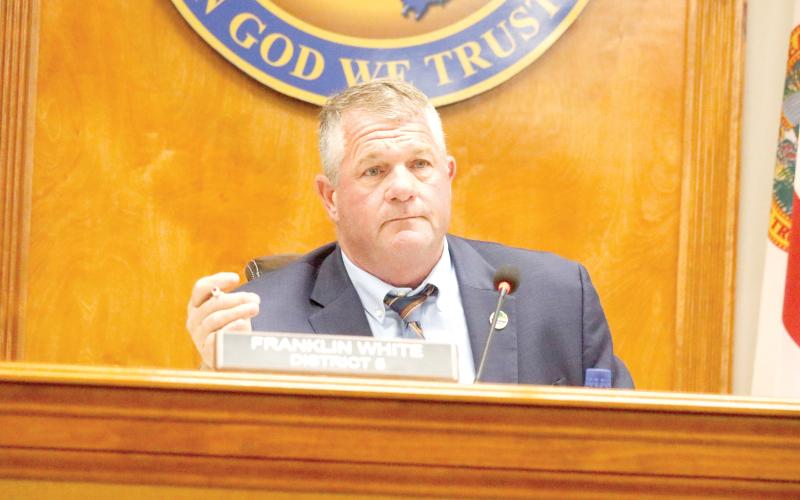 Suwannee County Commission Chairman Franklin White was authorized to send a letter to Columbia County rejecting its ultimatum on the North Florida Water Utilities Authority. (FILE)
Suwannee County will not be removing its commissioners from a regional utility board.
During its meeting Tuesday night at Live Oak City Hall, the Suwannee County Commission unanimously approved Chairman Franklin White signing a letter to the Columbia County Commission that rejects the request to remove elected officials from the North Florida Water Utilities Authority within 30 days. The board voted to give White that approval without discussion.
Prior to that vote, White read the two-page letter that was in response to an Aug. 7 correspondence from Columbia County Chairman Tim Murphy requesting the Suwannee board follow Columbia’s lead in removing elected officials off the utility group’s governing board. The Columbia Commission wants non-elected officials to serve on the NFWUA board to remove politics from the oversight of the utility partnership between the two counties.
“We are in receipt of your demand that Suwannee County appoint non-commissioners to the board of the North Florida Water Utility Authority,” the letter from White states, before getting to the county’s answer.
“No.”
The Columbia County Commission voted Aug. 6 to request Suwannee remove its officials within 30 days or it would begin the process of withdrawing from the utility authority. According to a 2024 interlocal agreement between the two counties, that process requires at least 180 days.
However, White states in the letter that it may not be that easy, alluding to a separate 2025 interlocal agreement between the two counties and the NFWUA. White suggests in the letter that Columbia County confer with its attorney before moving forward with its decision to pull out of the NFWUA.
“As a member of the NFWUA board, I promise to take good care of Columbia County’s capital assets over the next 5 years,” the letter states.
That 2025 interlocal agreement governed the transition of the utility assets from each county to the NFWUA and gives the authority the rights to operate and maintain all the assets for both counties through Sept. 30, 2030, or until the assets were transferred. It also automatically renews at the end of that term on one-year agreements unless either county doesn’t fund the NFWUA at that point.
White and fellow Suwannee Commissioner Leo Mobley, who serve on the NFWUA board, have both said in authority meetings that they didn’t intend to step down from the board until the utility facilities were transferred. White explains that again in the letter.
“We believe it would be irresponsible of us to remove commissioners from the NFWUA before we transfer capital assets worth tens of millions of dollars as commissioners are in the best position to set up Suwannee County and the NFWUA for success,” the letter reads.
“We respect Columbia County’s decision to remove commissioners from the NFWUA Board — we merely ask that Columbia County respect our decision not to.”
The letter also states that if Columbia County was so adamant that non-elected officials sit on the board, it should have negotiated that into the terms of either of the two interlocal agreements.
“Your ultimatum is an attempt to unilaterally change the terms of an interlocal agreement,” according to the letter. “Neither you nor we would permit such an act to work from a contractor. We certainly will not tolerate it from a fellow County which is supposed to be our friend, neighbor and partner in this venture.”
White also asks the Columbia County board to remember four reasons that led to the creation of the NFWUA:
- The state has told us repeatedly that future grants for utility projects will be awarded regionally and not on a county level;
- The NFWUA will save each county money as less staff are required to manage our collective assets;
- The NFWUA can more effectively manage utilities as it will bring necessary expertise in utility management — something both counties currently lack; and
- Assets in one county can benefit the other. For example, Suwannee County’s wastewater treatment plant near I-10 exit 292 can service Columbia County residents who are a stone’s throw away.
“If the NFWUA can get its feet off the ground, there is only upside and no downside for the people that matter — our constituents,” White’s letter reads.“As a board, we are choosing to consider your August 7, 2026 correspondence as something that was sent in the heat of the moment. We are going to move forward in good faith as friends, neighbors and partners — we expect Columbia County to do so as well.”
North Florida water and utilities authority
Concerned Citizens of North FL - Empowering Communities
08/13/26 Update
NFWUA MAY HAVE FOUND A WAY TO FLUSH ITSELF DOWN THE DRAIN
County will weigh options on utilities By JAMIE WACHTER jwachter@lakecityreporter.com If Columbia County moves away from its regional utility partnership, it will have to wade through several options for handling utility operations. County Manager David Kraus said Wednesday that county officials will determine which available option is best should the North Florida Water Utilities Authority collapse. Last week, the Columbia County Commission voted to deliver an ultimatum to Suwannee County, its partner in the utility authority: remove its elected officials from the group’s governing board or steps to dissolve the NFWUA would begin. “We’ll look at our options and determine which one is best,” Kraus said. “I can’t really say at this point because I haven’t had a board meeting to talk to the board members about it.” Kraus was out of town on vacation last week when the board voted to issue the ultimatum, which came after some heated discussion over the NFWUA’s budget and proposed rates. The NFWUA was created two years ago to handle operations and maintenance of the utilities for the two counties. Ultimately, the two counties aimed to transfer their utility facilities to the authority. That has not occurred yet and Suwannee County has said it doesn’t plan to remove its elected officials from the authority board until that happens. Whatever the county decides to do should it move forward with beginning the six month process of withdrawing from the interlocal agreement that established the authority, Kraus said the bottom line is quality service has to be provided to the customers of the county’s utilities in Ellisville. “It’s not as simple as saying, ‘we’re back in business,’” he said. “We have to guarantee a continuity of service. It’s not fair to our customers to say, ‘OK, we’re changing. We’re going to have to shut you off for a month.’ Whatever happens, we have to guarantee a continuity of service and a smooth transition. “You can’t not do that.” Kraus said he expects the commission to discuss their utility options — and the cost to the county’s budget — at a budget workshop next week. The board has a workshop at 9:30 a.m. today but Kraus said he didn’t expect utilities to be part of that discussion. As for what the possible options are, Kraus said the county could take the utilities back over themselves, but noted “that’s not a very good option.” “The difficulty with that option is we have already taken all of our employees and transferred them to the authority,” he said. Other options could be selling the county’s remaining utility facilities to someone and turning it into a private utility, joining the Florida Utility Authority, a statewide authority of county governments, continuing with the NFWUA or working out an agreement with the City of Lake City to run the utilities. The city and county reached a pact to let the city operate the wastewater treatment plant at the North Florida Mega Industrial Park last year that turned into selling the plant to the city. “From what I heard there was a lot of heated conversation,” Kraus said of last week’s county meeting. “Hopefully as we move forward, we can think through how we want to do what we want to do. The board is going to set the policy, set the direction. When they said they wanted to be out of the utility business, we said by October we’d come up with a plan to be out of the utility business. “If they say they want to do something, we’ll have to take some time and figure out that that takes and how we do that in a responsible way.
Columbia delivers ultimatum: No commissioners or no authority
By JAMIE WACHTER on Friday, August 7, 2026
Suwannee asked to remove elected officials in 30 days.
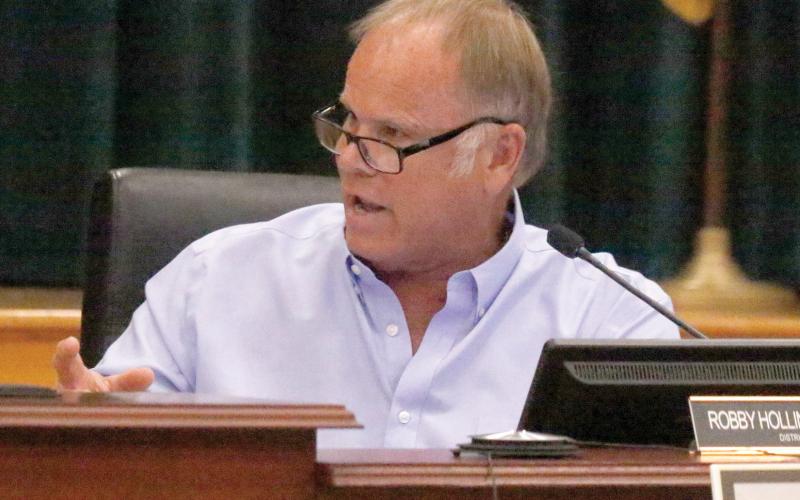 Columbia County Commissioner Robby Hollingsworth said if Suwannee County won’t remove its elected officials from the utility board then the county should look to leave the group. (JAMIE WACHTER/Lake City Reporter)
The Columbia County Commission may have flushed its regional utility authority down the drain Thursday.
During its meeting Thursday morning, the commission voted 4-1 to request that Suwannee County follow its lead and remove elected officials from the North Florida Water Utilities Authority board within 30 days or it would begin the process of withdrawing from the joint operation. The interlocal between the two counties calls that established the Authority allows either side to withdraw with a 180-day notice.
Rocky Ford, who had served on the NFWUA board, cast the dissenting vote after a lengthy discussion on the fledgling utility authority, including its budget subsidy request, proposed rate increases and a new authority board appointee’s concerns about its viability.
Commissioner Robby Hollingsworth issued the ultimatum, saying he believed that the politics needed to be removed from the authority’s operation so it could be run like a business.
“In a three-day period, they changed it and I get why they changed it, it’s just politics,” Hollingsworth said as the NFWUA quickly pivoted last month with proposed rate increases to lessen the impact on customers due to requests by both Ford and Suwannee Commissioner and NFWUA board member Franklin White.
“The only reason it got changed was for politics…I know we can’t vote on rates but we can vote on asking the Suwannee County Commission to remove themselves from the board within 30 days, appoint somebody, and if they won’t do that, I think we should begin dissolution of the NFWUA if we can’t get all the politicians off. Politicians should not be on a water utility board.”
Those rates and “discrepancies in this budget” were issues for County Commission Chairman Tim Murphy, who said he asked for the discussion of the NFWUA at Thursday’s meeting to try to get a better understanding of what the county wanted to do with funding the Authority before it got to the “last minute” of its own budget discussions.
“The transparency issues that have taken place in the Water Authority in the last 90 days, this has evolved right here,” Murphy said.
Among those transparency concerns for Murphy included NFWUA Executive Director Shannon Roberts telling the Suwannee County Commission on Tuesday that the rate changes were offset just by increasing the two counties’ contributions to fund the utilities’ operations. In reality, the rate changes were offset also by reducing the amount the NFWUA was planning to put into contingency and reserves.
“My biggest heartburn with this budget is this board…has never, ever balanced a budget on contingency or reserves,” he said. “This budget right here was balanced on contingency and reserves. I will never vote for this right here. It’s ridiculous.”
Jock Phelps, a recently appointed member to the NFWUA board but who has yet to be sworn in to that position, told the commissioners Thursday that he also had “grave concerns” about the NFWUA after getting a closer look at their budget and operations. Phelps, who was chosen by the Columbia BOCC last month along with Walt Graham to replace Ford and Murphy on the NFWUA board following a pair of July meetings, provided nine areas that concerned him after attending a pair of NFWUA meetings and poring over its budget.
“I have no agenda, I’m not being paid for my services in any way,” Phelps said, adding again that he had “grave concerns” with the NFWUA.
Phelps’ concerns included:
n No mission statement for the authority, which means there is no clear direction for the group;
n No projected growth rate of the customer base on which to prepare a budget;
n The planned alternate budget for the NFWUA of $4.379 million equates to $10,975.97 per customer with only 399 customers served currently;
n A shortfall of actual utility operations revenue compared to the budget total of $4.332 million that has to be made up through a combination of grants, subsidies from the two counties or rate increases;
n The proposed rate increases all going up dramatically except for commercial water users in Fort White, which decreases, something Phelps labeled as a ‘RED flag;’
n The proposed rate increases not actually covering the counties’ subsidies;
n A concern that customers may seek other options for water or wastewater service due to the significant rate increases proposed;
n The start-up authority already having an executive director, accountant and attorney and now also seeking a lobbyist while still not owning any assets; and
n The partnership between the two counties not being equitable with Columbia County generating the majority of the income for the NFWUA but the two counties share expenses and revenues.
Richard Powell, the NFWUA’s financial consultant, disagreed with Phelps’ interpretation of the budget in a statement released to the Reporter on Friday through NFWUA Executive Director Shannon Roberts, who declined to make any comments of his own.
“I believe there were significant inaccuracies made in Mr. Phelps presentation regarding the Authority’s finances and budget, and subsequent comments made by Board of County Commissioner members who likely were misinformed as to the facts of the issues raised,” Powell said in the statement, noting he would address the inaccuracies in detail at the NFWUA’s next meeting, which is Aug. 17 in Lake City.
Ford said Phelps’ concerns and complaints were directed in the wrong place. He said with the commissioners no longer serving on the NFWUA board, Phelps should take his concerns to Roberts and the utility board at its next meeting.
“We don’t sit on that board any more, we don’t have any say so over that board any more,” Ford said.
But the commission does fund the utility with a proposed $520,648 subsidy as well as $100,000 for reserves. The county also must approve any rate increases on customers in the county because it still owns those facilities.
“The reason I came before you is because you’re fixing to vote on giving money to a board,” Phelps said. “You’re not fixing to spend thousands of dollars, you’re not fixing to spend hundreds of thousands of dollars, you’re fixing to spend millions of dollars.”
Ford, following Phelps’ presentation, asked what the Commission was discussing when it came to the NFWUA, whether it was to stop funding the Authority or killing it. Calling it “planned,” Ford said he received a call prior to the meeting Thursday morning that warned him the plan to end the NFWUA had been discussed over the weekend on “the river.”
Ford also said if the board planned to pull the county back out of the NFWUA, he wanted staff to bring back a plan for how it would operate utilities moving forward by the next meeting. That is something, he said, it has continuously failed to do in the past, including not having raised rates since it began utility operations in Ellisville about a decade ago or forcing mandatory hookups there.
“That’s why a county can’t run utilities and why a Board of County Commissioners can not run utilities,” Ford said. “They vote to try to get re-elected. They don’t vote to do a business model like it needs to be.
“That’s why this Utility Authority was started and why it’s so important.”
Ford added that as long as the county owns the utility assets, it will continue to set the rates. Earlier in the meeting, the commission did agree to set a public hearing for its Sept. 3 meeting to consider the proposed rate increases on customers in Ellisville and Mason City.
The average bill for residential water users in Ellisville and Mason City will pay $53.56, a 33% increase; while commercial water users will pay $438.55, a 65% increase; and commercial wastewater users will pay $799.52, an 11% increase.
Murphy also said Thursday that he was not in favor of the proposed rates, even the reduced ones, and wouldn’t ever vote for them either. He pointed to the county’s approach in raising fire assessments, never going with the full amount that a rate study suggests.
“We increase it slowly, solid growth I call it,” Murphy said.
The board, though, did not approve the authority’s budget subsidy request, tabling that vote until the first meeting in September as well. Kevin Kirby, the assistant county manager, said the county would plan to use the numbers requested as part of its budgeting process until the final numbers are set.
Foreman added that it would probably work out better to wait to approve the subsidy request at the same time as the rates.
“I’m assuming, based on how math works, that if you approve lower rate increases than they will have a higher supplement,” he said.
Suwannee commissioners won’t be ‘told what to do’ on NFWUA
By JAMIE WACHTER on Friday, August 7, 2026
White, Mobley stick by decision to remain on board.
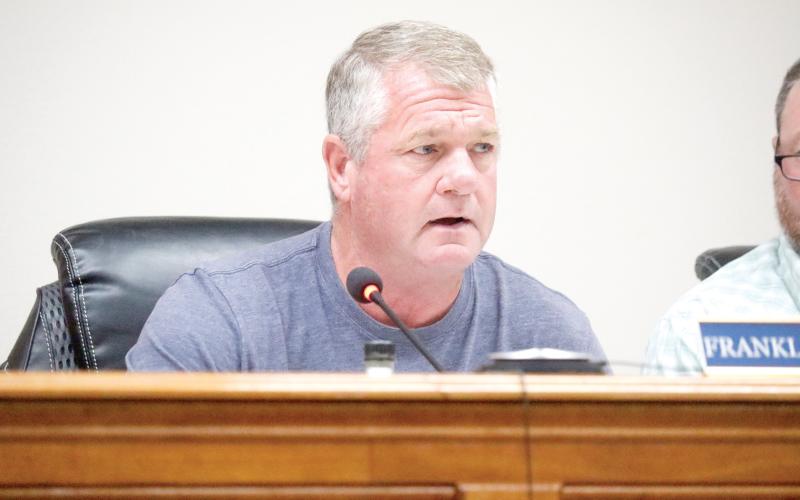 Franklin White, the Suwannee County Commission chairman and the vice chairman of the North Florida Water Utilities Authority board, said he won’t ‘be told what to do’ after the Columbia County Commission issued an ultimatum Thursday to get elected officials off the authority board. (FILE)
LIVE OAK — Columbia County may ask, but a pair of Suwannee County commissioners don’t plan on complying with the desire to stop serving on the regional utility board.
After the Columbia County Commission voted to issue an ultimatum to Suwannee County to remove its two commissioners sitting on the North Florida Water Utilities Authority board within 30 days at its meeting Thursday morning, both Franklin White and Leo Mobley told the Reporter on Thursday afternoon that they intend to remain on that board.
“I ain’t going to be told what to do,” White said. “If that tells you anything.”
Mobley added: “I’m going to stand firm with being on there until the end.”
Columbia County Commissioner Robby Hollingsworth said he felt Suwannee County needed to follow Columbia’s lead in removing elected officials off the utility board in order to get politics out of the fledgling utility’s operations and allow it to be ran like a business.
The Columbia Commission voted 4-1 to ask its Suwannee counterpart to appoint other people to the utility board within 30 days or begin the process of withdrawing from the joint arrangement.
However, White and Mobley said Columbia County’s request doesn’t change their belief that elected officials need to remain in oversight of the NFWUA as long as the county still owns its utility facilities.
The NFWUA has discussed the transfer of the seven utility assets between the two counties but that process has not been concluded.
“The way I look at it is until the assets are transferred, you’ve got to have a commissioner on there or someone elected for accountability, someone to cover our assets,” Mobley said. “Until (the NFWUA’s) hands are out of our pockets, we’re going to sit on the board.
“Until we have the assets switched over, I don’t see how in the world you could make the decision for elected officials to be off the board while dealing with county assets.”
White said it is a point he has made multiple times and will continue to do so.
“It’s still taxpayer assets until it’s transferred,” he said. “I’ve always said I will stay on the board until the assets were transferred.
“I’ve said it many times. It wasn’t that long ago that I said it again. It shouldn’t surprise anybody. They can do whatever they see that they need to do but Suwannee County will not be getting off the board until the assets are transferred.”
If Suwannee County’s Commission as a whole agrees with that belief, it means the NFWUA, which began two years ago as a combined effort between the two counties to handle operations and maintenance of the utility facilities across both jurisdictions, could be disbanded by early next year. The interlocal agreement between the two counties that created it provides a six-month withdrawal period by either party.
Mobley said he hopes that cooler heads can prevail and the NFWUA can remain moving forward. But he added that there are consequences to actions like issuing ultimatums to a partner as well.
“I believe it can be worked out,” he said. “But I don’t think so on one hand…The whole time they’ve been trying to figure out a way to get out of it, wasting a lot of time.”
White, though, said he didn’t know if there was salvaging the NFWUA at this point since it will reside in Columbia County’s hands. However, he said he hopes it continues to operate.
“If they keep doing things like this, I don’t see how it goes forward,” he said. “They should have had the conversation with us that we want you to get your two guys off the board. You didn’t have to do all you’ve done. Just come to a meeting and say you want us to get off the board. But I’ve told them I’m not getting off the board until the assets are transferred. I don’t know what they don’t understand.
North Florida water and utilities authority
Concerned Citizens of North FL - Empowering Communities
04/22/26 Columbia County Not Committed to NFWUA, Is The $130K Study Valid with Mega Site Plant Sale To Lake City?
NFWUA board: Are we ‘all in’ on utilities? By JAMIE WACHTER jwachter@lakecityreporter.com Columbia County’s decision to sell a sewer plant has members of the North Florida Water Utilities Authority questioning its direction. At the end of the NFWUA’s meeting Monday morning, multiple board members questioned what the pending sale of the North Florida Mega Industrial Park utility to the City of Lake City means for the fledgling authority moving forward. “You’re either in or you’re not,” NFWUA Vice Chair Franklin White, a Suwannee County commissioner, said Monday. “We’re either all in or we ain’t.” White’s thoughts came after at-large NFWUA Board Member Steven Dicks said it raised concerns about the impact of the sale on the Authority and a rate study the board had performed by a consultant as it seeks ways to financial viability and stability. That rate study by Raftelis included the NFMIP wastewater plant, which opened a year ago and has been operated by the city under an interlocal agreement. UTILITY AUTHORITY Joint board concerned with direction after sewer plant sale. In addition to that impact, Dicks said the sale — which the County Commission approved by a 4-1 vote with Rocky Ford dissenting before the Lake City Council approved the $1.591 million purchase unanimously at its meeting Monday night — also had him concerned about the purpose of the NFWUA. “I’m a little misunderstanding what our role is,” he said, noting he believed the goal was to, over time, create a regional utility authority that would cover all water utilities throughout Columbia and Suwannee counties, maybe even eventually the municipal systems. “So I’m a little concerned there. “I thought … we were all on the same page but, obviously, we’re not all on the same page in some of these areas and I would like to see us get on the same page and focus our efforts to make it work.” White also said he was under the impression the NFMIP plant would be an Authority asset moving forward. Ford, who also serves as the NFWUA chairman, agreed with both Dicks and White following a backand-forth between himself and Tim Murphy, the other Columbia County commissioner that serves on the NFWUA board. “I agree, you’re either in it or you’re not,” Ford said. “All I hear is Columbia County doesn’t want to be in the utility business. You have an option here with a contract with this Utility Authority. I don’t know why you wouldn’t invest in this Utility Authority.” Murphy said Monday, much like he did in the County Commission meeting last Thursday, that he thought it was a better business decision moving forward for the county to focus its utility efforts at the Ellisville exit off Interstate 75. The county is considering applying to the U.S. Department of Agriculture for $38 million in funding toward a new wastewater treatment plant at that exit to help provide capacity for a massive Busy Bee convenience store that is expected to open by late summer 2027 and additional future growth. “That will bring the North Florida Water Utilities Authority into the black much, much faster,” Murphy said. “There’s a faster return there, that’s all I’m saying.” The discussion on the plant sale began with Ford informing the other board members of that action Thursday. Murphy then continued in it when he questioned what he called “overreach” by NFWUA Executive Director Shannon Roberts, who spoke out against the sale at the county meeting. Roberts had also sent in an AI-generated document that looked at the pros and cons of the proposed sale to county officials. “All the cons basically of us making that decision the other night,” Murphy said, asking who gave Roberts the authority to make that presentation on behalf of the NFWUA. Roberts replied that Ford told him to. “Where’s the rest of us in that conversation?” Murphy asked. “There’s more people that run this board than Mr. Ford.” Murphy also said Ford and Roberts had plenty of time to make their own pitch to the county commission if the NFWUA wanted to operate the sewer plant at the industrial park. Currently the city is redirecting flow from the Lake City Correctional Institution from its St. Margaret’s plant to the NFMIP plant to get it operating. “The reason why the proposal never came forth is simply there is no proposal that you can put together outside the Board of County Commissioners wholly funding this, the shortfall,” Murphy said. Ford, pointing to the sale agreement with the city that calls for the county continuing to help with various aspects at the NFMIP, including making sure the deep well injections are completed for the plant, questioned whether the city would be able to fund the operations of the plant too. He also, much like he did in the commission meeting, said he just didn’t understand the rush to vote on the sale. The county’s interlocal agreement with the city to operate the plant with a cost-share or revenue-share aspect has at least another year to go. “Here’s the thing Tim, if it’s a good contract, it would still be good a month from now or two months from now,” Ford said. “If it’s a good deal for the county and the city, all I was pointing out is, what is the rush? Let’s have a meeting on it and discuss the pros and cons. You shot that down immediately.” Murphy also shot down the pros and cons list that Ford and Roberts presented to the commissioners as “AI garbage” and a “souped-up fifth grade deal.” Ford, though, said most major corporations utilize AI, taking offense with the label “AI garbage,” claiming Murphy was showing his ignorance of the power and effectiveness of AI. “I’ll still say it’s garbage and I’m pretty sure Columbia County showed… the Columbia County Board of County Commissioners showed, we showed AI what it was by a 4-1 vote that it’s garbage.”
County agrees to sell plant to city
By JAMIE WACHTER on Friday, April 17, 2026
 Columbia County Commission Chairman Tim Murphy (left) and Commissioner Rocky Ford (right) engage in a back-and-forth shouting match during Thursday’s meeting over the sale of the wastewater treatment plant at the North Florida Mega Industrial Park to the City of Lake City. (JAMIE WACHTER/Lake City Reporter)
Columbia County is selling the North Florida Mega Industrial Park wastewater plant to the City of Lake City.
Following more than an hour of discussion Thursday night during a public hearing on the potential sale, the Columbia County Commission voted 4-1 to sell the sewer plant to the city, which has been operating it for the past year since it opened. Commissioner Rocky Ford vehemently disagreed with the sale, instead asking for a workshop to be held on the topic to try to add “safeguards” to the agreement.
“I want one of you to tell me why this is a good idea, explain to me why this is a good idea,” Ford said during the discussion. “I’m at a loss.
“We’re giving the whole house away. We’re selling the farm for pennies on the dollar.”
The Lake City Council, which is expected to discuss the plant’s purchase at its meeting Monday night, also has to hold a public hearing on the matter before it can approve the deal. According to the agreement passed by the county, the sale is expected to close May 29. The city is paying the county $1.591 million for the plant, which covers the county’s out-of-pocket costs on constructing the facility. The city also will take on repaying the county’s $5 million loan from Florida Commerce to help complete the construction and other obligations tied to the grant funding that covered the majority of the $30-plus million plant.
That agreement, though, did not include any controls on the rates the city could potentially charge in the future or any portion of the profits off the plant’s operations.
Those were items Ford said he would like to see discussed between all the stakeholders, including the North Florida Water Utilities Authority, before moving forward with a potential sale. Ford added the interlocal agreement between the county and the city that allowed the plant to begin operations utilizing flow from a city customer still had a year or longer before it ended. That time, he said, would allow those discussions to take place and make sure “everybody comes out winners on this.”
Commission Chairman Tim Murphy said he thought the county had the “upper hand” in the sale in his view as he and Ford faced off in a verbal sparring match over Commissioner Robby Hollingsworth for several minutes prior to the vote.
“This is a business decision,” Murphy said, pointing to his belief the county was better off focusing its attention on utility needs in Ellisville. “I would rather put my risk there.”
Prior to Ford providing his objections to the deal, both NFWUA Executive Director Shannon Roberts and Florida Gateway College President Larry Barrett also spoke against the sale.
Roberts said the sale didn’t just turn over a sewer plant to the city but gave them a monopoly on utilities on the eastern side of Columbia County, including at the NFMIP, a huge target for economic growth and development in the county.
“Essentially the agreement shifts county-led economic development to a city-controlled utility game that affects development,” Roberts said. “In the future if Lake City should pursue some type of annexation, that move would make every economic development deal in the region more expensive and less competitive, which could likely lead to a future loss of commercial ad valorem revenue at a time when commercial ad valorem revenue has never been more important.
“With this deal, the county is certainly a short-term winner economically…but I believe the county will be a long-term loser.”
Ford later said by turning over control of utilities at the park to the city, the county had given away all of its say in trying to bring in companies.
“If we sign this contract, I don’t even know why we have an economic development department,” Ford said. “We can do away with that too. The city will be running economic development for the people in the county at that point.”
He later added: “It’s a known fact, a proven that, that whoever runs utilities runs economic development.”
Steve Brown, the city’s executive director of utilities, immediately replied: “Then you’re in good shape because I’m running the utilities.”
Brown told the board repeatedly Tuesday that the only reason he was there is because the county had declared previously it wanted to get out of the utility business. So he and the city decided to offer to assist with operating the NFMIP plant rather than it be “mothballed” as County Manager David Kraus described it at the time.
Brown added the city always hoped to eventually purchase the plant from the county after entering into the interlocal agreement. Hollingsworth added that the county had the plant built to city specifications because it originally was going to be turned over to the city to operate.
“We purposely looked at, ‘Let’s show good faith, let’s make this thing work and then purchase it,’” Brown said, adding he would never say no to providing utilities to a potential customer at the plant unless it would be a bad fit, including needing more capacity than what the plant could provide. “I’m going to take every customer I can.
“I’m all in. I want as many customers as I can get online. Economic development is something that has to happen. We have to have the county, the county needs the city, we have to work together. I’m all in.”
While Ford and others said that interlocal agreement was working well for both sides, he pointed to missteps in the past between the two governments when it came to utilities and infrastructure, including delays in advancing other projects as well as using utility revenue to supplement the city’s budget.
“History is history and it is very evident to me that I can’t outrun no matter how fast I run,” Brown responded.
Brown, though, also added that the city had turned a corner in providing utilities — as well as not using utility revenue to boost up its general fund this fiscal year — and being a willing partner to work with the county. He pointed to not only the willingness to divert the Lake City Correctional Institution’s flow to the plant to get it up and operating, but also the city using its labor and parts to solve an issue with AgroLiquid, the first tenant at the park, to get them connected to the city’s sewer system.
Barrett’s concerns stemmed from the city’s utility focus being on expansion and growth areas rather than upkeep and repairs on its current system, noting there are issues with its sewer line that runs through the college campus.
“One has to reinvest in utilities not just growth,” Barrett said, also agreeing with Roberts that turning over the plant to the city meant ceding control of economic development decisions to it as well. “Is that what the plan for the North Florida Mega Industrial Park will be in 10 years? As an educator and as a college, we attempt to educate our students with critical thinking skills. One of those skills is reviewing holistically a problem. The past issue of governmental organization is a good indicator of how the future will go. The history of the city with the college and the county is not a good indicator for the North Florida Mega Industrial site.”
North Florida water and utilities authority
Concerned Citizens of North FL - Empowering Communities
North Florida Water Utility Authority: Unprepared, Unorganized, No Business Plan, No Experience, Spending Money Like Water – Welcome to Never-Never Land
Story credit: Columbia County Observer
https://columbiacountyobserver.com/
August 1, 2025 7:45 am | 6 min read

County Attorney Joel Foreman opines as County Manager David Kraus looks on. Columbia County Observer photo
By Stew Lilker
COLUMBIA COUNTY, FL – The North Florida Water Utilities Authority (NFWUA) met Wednesday morning. The Authority, operating without a business plan for over a year and with an executive director who has no experience running any kind of utility, trudged forward into its self-created Never-Never Land.
The action began before the meeting got underway as NFWUA Executive Director Shannon Roberts handed out an interlocal agreement that was not complete when posted to the Authority’s website on July 24 as part of the meeting’s agenda packet (the meeting material).

Columbia County Commissioner Rocky Ford has been at the helm of the NFWUA since the beginning. The Authority's track record speaks for itself.
Missing – everything needed to make a decision and inform the taxpayers
Missing were the exhibits from the interlocal agreement (ILA - an agreement between Columbia and Suwannee Counties and the Authority), which identified the water and wastewater assets that were to be maintained and operated by the Authority and the budget.
Also missing was the NFWUA budget to run those utilities.
Why is this important? The Authority’s funding is coming from the pockets of all Columbia and Suwannee County taxpayers. It was on tap to be approved that morning by the Authority Board members, which included county commissioners from their respective counties.
Executive Director Roberts' lack of relevant governmental utility or other experience also resulted in the material posted on the NFWUA's website not being ADA compliant (handicapped accessible).
When the lack of ADA compliance was pointed out to the Authority members, each a county commissioner – they just shrugged.
Joel Foreman short-circuited the NFWUA enabling document
Looking back to before there was an Authority, Columbia County’s expert in legislative matters, Staz Guntek, in 2022, put together various scenarios of forming a utility authority and presented the names of multiple authorities, including the Okeechobee Utility Authority enabling documents as a suggestion.
Mr. Guntek was thrown overboard by Columbia County County Attorney Joel Foreman, who had a better idea, form the Authority after one of the most problematic special districts in North Florida, the Suwannee Valley Transit Authority. Mr. Foreman worked to shoehorn the Utility Authority into the SVTA’s enabling papers, which were eventually approved.
NFWUA Chairman Rocky Ford and Suwannee County’s Franklin White both questioned the vital missing material.
Executive Director Roberts explained that when the agenda was created, they didn't have the missing material (exhibits A, B, C), and the final assembly of the material was done "yesterday,” at which time Mr. Roberts said he printed off some copies for the public and brought them to the meeting. He did.
Columbia County printed more copies of the interlocal agreement and exhibits so that the Authority Board members had complete copies.
NFWUA Attorney Grady Williams called the interlocal a “kickoff strategy.”
The interlocal agreement can be viewed or downloaded here. The 12th hour additions begin on page nine.
The ILA: running millions of dollars of county assets -- no big deal, "like getting your learners permit... it's an experiment." County Attorney Joel Foreman

Columbia County Attorney Joel Foreman opines as County Manager David Kraus looks on.
Columbia County Attorney Joel Foreman compared turning over the running of tens of millions of dollars' worth of utility assets to "getting your learner's permit." He said, "It's sort of like handing the keys over to the car, right? You got your learner's permit, you’re 15. We're going to see how you do between 15 and 16. So this Interlocal is kind of like that learner's permit, right? You gotta do your thing. We're gonna be looking over your shoulder. We'll be checking in from time to time... Let's see what you can do…We know this is an experiment... If things go sideways, the counties are protected, because we can undo this.”
Suwannee County County Attorney Adam Morrison, who co-authored the ILA (interlocal agreement) added to Mr. Foreman’s learner’s permit scenario, “There will be growing pains; there will be screwups.”
Chairman Rocky Ford said, “I like what Mr. Morrison had to say about growing pains… I think we're making some good headway."

Commissioner Tim Murphy: He wanted a finished agreement before moving forward.
Columbia County's Tim Murphy took exception to the rush to push through the ILA, noting the 12th hour additional materials. “I don’t think we’re under a deadline here,” he said.
County Attorney Foreman protected his position, “The Interlocal allows for us to constantly come back to the table - say, hey, got an issue.” Mr. Foreman explained, “I also want to reassure you that if you don't address a disagreement at the very same meeting” we could do it at another time.
Mr. Foreman continued his explanation, “You know, we start to take that baby step, and first thing you do is step in a bear trap and it's not a catastrophe, the way we drafted it. Nothing is a catastrophe.”
What about the customers?
Finally, someone mentioned the utility customers. Columbia County County Manager David Kraus said, “The biggest thing we want is a smooth transition for our customers. You don't want a utility billing interruption, and then suddenly you have problems collecting payments because they didn't get bills. So, you know, transition for our customers is equally important.”
At this time, it is not clear how many Suwannee County utility customers there are or if they are all being billed.
Executive Director Shannon Roberts knows, but isn’t talking. He is still doing work for Suwannee County, is using their offices, and is being paid for that work in part by Columbia County taxpayers.
Suwannee County's Adam Morrison likes growing pains

Suwannee County's Attorney Adam Morrison: "There will be screwups... and growing pains."
Back to growing pains came Suwannee County’s Adam Morrison, “the one thing I like about this problem (billing) is the idea of growing pains; this is the training bill before you get the car. Because if for some reason this goes south, you don't want to spend all the money transitioning everything into this new [billing] system.”
Attorney Foreman backed up his co-ILA-author: “Everything you do, as long as this Interlocal is in place, needs to be reversible, right? Because, again, the consequence of everything falling apart is that everything goes back to where it started, right? If you do anything irrevocable, like you spend money on servers. They're not going to take them back. Somebody's getting up with servers that they didn't even want. You want to avoid creating too many of those kinds of situations during this Interlocal… You're going from the learner's permit to a full driver's license.”
County Attorney Foreman left out the part that if the Authority had hired an experienced utility director and had a business plan and model, and a rate study, they wouldn’t have to spend half their time looking over their shoulders.
Commissioner Murphy stuck to his guns, telling the Authority that the executive director should put together an agreement that “everybody understands and then bring it back to the board.”
Now comes Kevin Kirby

Assistant County Manager Kevin Kirby. "We don't track repairs." Where is the County internal auditor – Jay Swisher, Clerk of the Court.
How much do Columbia County's utility repairs cost?
Kevin Kirby is the long-time county public works director, and according to the County organizational chart, the co-county manager, although his payroll title is assistant county manager.
Mr. Kirby weighed in, announcing for the first time anywhere, "Since we have been in utilities, we have never documented repairs, and they happen quite frequently."
County Attorney Foreman shared that he thought “there could be some estimates.”
Mr. Forman’s ILA partner, Attorney Morrison added, “The real point of this agreement is to get a macro understanding at the 30,000-foot level as to what everybody's expectations are.”
Executive Director Roberts was taking heat because he didn’t have a monetary figure for repairs in his presented budget.
Mr. Kirby helped him out by explaining the Columbia County way of doing business: "Long story short, in your defense, I can speak to Columbia County. For clarification, it's not budgeted. That activity is not budgeted. We simply rob it out of the road department.”
Greg Scott, Suwannee County's County Manager, weighed in

Suwannee County County Administrator Greg Scott. His experience running a county came from being the Director of Recreation.
Mr. Scott said he wasn't sure if Suwannee County had a utility budget, and he explained that when something broke, they just called somebody. The person was not under any kind of emergency repair agreement; they just called.
Mr. Murphy weighed in again, “I don't see the rush. And I feel like your attorneys can hit on this and get with the proper parties involved and work these things out. I'm not going to support the MOU [sic-ILA] today.”
Commissioner Ford tried to convince Mr. Murphy.
Mr. Murphy said they were supposed to be “here for the taxpayers” and that no one on the Authority Board "would run our operations [businesses] that way."
Mr. Murphy concluded, “I just don't see the necessity for the speed of this to be signed today.”

Suwannee County Commissioner Franklin White knew there was something wrong. In the end – he rolled over.
Suwannee County’s Franklin White said, “I think it's just a review today, is it not?”
Chairman Ford, who everyone acknowledges is driving the NFWUA ship, said, "Right now, Columbia County and Suwannee County are still gonna own all the assets. So, if there’s a major catastrophe at one of those assets, they [respective counties] still own it.”
Mr. Foreman spoke about how there would never be a perfect interlocal agreement.
Mr. Ford said, “All attorneys agree right now, this is a very good start.”
Mr. Morrison added, “Until you get started, you don't know what the problems are. Everything is theoretical.”
Mr. Ford again said he wants to get going.
Mr. Morrison said, “Joel [County Attorney Forman] and I talked about this. I don't think it sounds crude. We're just making it up.”
There was more talk.
Mr. Ford said, “I'll entertain a motion. We had plenty of discussion.”
Suwannee County’s Franklin White, the Authority member who said he thought the ILA was for review, made the motion to approve the ILA as written. Suwannee County’s Leo Mobley seconded it.
Mr. Murphy was the only one opposed.
Epilogue
With no rate study, no business plan, no one running the Authority with any experience, and an incomplete budget, the NFWUA marched forward.
A word to the wise to the taxpayers and law-abiding citizens.
Keep your eye on the Columbia County landfill and the deals Suwannee County and Columbia are making.
There may be more here than meets the eye.
Comments (to add a comment go here)
• Fair Use • Privacy © ColumbiaCountyObserver.com
North Florida water and utilities authority
Concerned Citizens of North FL - Empowering Communities
North Florida Water Utilities Authority (NFWUA)
My Take-The short version
May 11, 2025
NFWUA is a self-appointed group that wants to control water and utilities using our money.
“No customers, no assets, no business plan, no strategic plan, a political insider book keeper, a clerk that can’t keep the Authority minutes up-to-date, and no employees.” (Reprint from Columbia County Observer)
Early in 2024 North Florida Professional Services (NFPS) started to lobby Suwannee, Hamilton, and Columbia county commissioners to create NFWUA and the answer I got from my commissioner, was it will save money(not in my opinion),you will see why. At the time there was an effort to get more counties and cities involved but none bought in, and Hamilton never started. To get it all started Dale Williams an employee of NFPS was put in place as interim director. Almost immediately Mr. Williams signed a task order to NFPS for a director search in the amount of $64K. The result was zero since no one applied.
Then two county commissioners Rocky Ford and Tim Murphy from Columbia County and Franklin White and Leo Mobley from Suwannee County and an independent citizen Steven Dicks were self-appointed to the board. Each county put in $250K to date in the kitty.
Here is where the money gets spent pretty quickly, as best I can tell, since meeting minutes are not on their website by the Columbia County clerk, and no video or audio.
· Hired Grady Williams as attorney for a retainer of $6,000 per month, plus litigation fees. For reference Suwannee County pays their attorney a retainer of $2,500 a month plus litigation which usually ends up about $7,000 a month.
· Next Ratellis Financial is hired to do a rate study to the tune of $130K. I am not sure how you do a rate study when Suwannee has 1 to 2 commercial customers (ref: Suwannee County Utility Infrastructure project update 1/7/25) and Columbia has about 15 to 16.
· Hired Bobby Payne Consultants, LLC to do a business plan at $5,000 per month with no end date; you would think this would be the first thing to do. If you don’t know the goals and direction of a business how do you go forward?
· Hired Multi Creative, Inc. to create and maintain a website $4.7K
· Hired an auditor $15K, not quite sure who again no meeting minutes posted.
· At a meeting on 4/17/25 Shannon Roberts (Suwannee’s primary Grant Administrator) was selected as Director, salary to be negotiated, which was set at the May 7thmeeting of $125K plus benefits for a total of $199,083. Not quite sure what he will do other than collect a check, and help spend our money. There was a split vote of 3 to 2 to approve the compensation package.
· Workman’s comp insurance $$1.4K
· Average miscellaneous expenses approx. $400.00 month =$4,800 yearly
· With information available of the $500K from both counties $517,083K is committed of taxpayer money, and surely they will want much more from each this year just to survive. Rocky Ford stated at the 4/17/25 selection meeting we will need to get more money from each county at budget time.
If the goal is truly to save money then perhaps rather than hire outside consultants the authority could be using the resources currently available in each county such as: attorney, website already in use, accountants, auditors, etc. The key for me is without first doing a business plan, how do you make reasonable decisions. When asked about the business plan, the answer was it will be delayed until the rate study is complete sometime in August. To pay an administrator $200K to manage very little is not good business, and certainly not good use of taxpayer money.
When I ask questions about the Authority the general answer is this takes the politics out of it. I must be looking at something totally different County Commissioners. I have asked where the return on investment is, and the Chairman replied there is none but you have to be prepared to bring businesses into the area. My reply at what cost to the public. Both counties have previously been working on infrastructure at their business parks and have been successful receiving grants to accomplish that goal. Do we really need another layer of government to spend our money?
Here is the real kicker per the interlocal agreement section Xa.”It is the intention at this time of entering this agreement that upon further authorization and approval by each affected County, and approval of the Board itself, that the Board shall own and operate all combined water, wastewater, and reclaimed water system assets of the Counties in accordance with such rules and policies as it may adopt with the assistance of the Administrator. In the event such conveyance of ownership occurs, this Agreement may be revisited for purpose of consulting future Boards.”
This is a very short version of what has taken place in the last year, make your own decision what is really going on here with an Authority which the people have no control over spending our money with no return on investment in sight. If you agree with me contact your respective county commissioner from Columbia and Suwanee County and tell them to stop the Authority now and not fund any more of our money.
WayneF. Hannaka www.concernedcitizensofnorthfl.com
North Florida water and utilities authority
Concerned Citizens of North FL - Empowering Communities
North Florida Water Utility Authority: $150,000 a year plus a $51,000 yearly pension payment (plus) too much for an executive director for two Authority board members
May 9, 2025 8:15 pm | 7 min read

By Stew Lilker
In a rush: read the 1 minute version here.
SUWANNEE COUNTY, FL – $150,000 a year plus a $51,000 yearly pension payment (plus) was too much for an executive director for two Authority board members.
The struggling North Florida Water Utilities Authority met on May 7, 2025, in Live Oak for its regularly scheduled meeting. Among other things, the Authority was trying to figure out how much to pay its chosen executive director, who has no prior experience running or operating a utility.

As reported in mid April, the Authority had finally chosen a candidate for executive director: Shannon Roberts, a Suwannee County Administrator. Even though a monkey wrench was thrown into the works, the choice was never in doubt.
Earlier, on April 2, the Authority met to interview its two and only candidates: North Florida Water Utilities Authority: NFWUA Finally Has Candidates for Executive Director, But Are They Qualified?
During that meeting, Suwannee County employee, candidate Roberts's responses to written questions were made available: "Do you possess a degree in public administration, engineering, environmental science, or a closely related field? Please list degree type (e.g., B.S., M.S.) and area (e.g., Environmental Science). Please list the degree type. Do you possess any related licenses issued by the State of Florida or another State?"
Mr. Roberts answered that he had a BA in Psychology from the University of North Florida. Mr. Roberts said he had no related licenses but could obtain them "given the proper time and financial support."
During the April 2 meeting, NFWUA Chairman Rocky Ford established a negotiating committee. NFWUA vice-chair Franklin White (Suwannee County) nominated Columbia County Commissioner Tim Murphy to “negotiate for the board.” Chairman Ford asked if Mr. Murphy “had a problem with that.” He didn’t.
Commissioner White didn’t think it was proper for Suwannee County to be negotiating with its own employee.
The negotiating session was scheduled for April 30. On Saturday, April 26, Mr. Murphy, without any authority to cancel anything, canceled the negotiating session.
The meeting cancelation notice didn’t make it to the NFWUA website until recently.
Mr. Murphy left the NFWUA board and the Suwannee County Commissioners in the position to negotiate directly every detail of the contract with Mr. Roberts at its May 7 meeting.
How much is an executive director without
utility operational experience worth?
May 7:
North Florida Utility Authority Negotiates – It wasn’t pretty
Tim Murphy's cancelation of the negotiating session would have enabled many of the sticking points to have been either worked out or well-researched before the general meeting. They weren't.
The question before the NFWUA board: How much is an executive director without utility operational experience worth?

Shannon Roberts takes notes in the audience. He had his own ideas of his value.
Suwannee County's Shannon Roberts had his own ideas. Mr. Roberts filed documents with the Authority representing his research on how much he should be paid. He found salaries ranging from almost $300,000 to a low of 52,000. Mr. Roberts wrote that the average public utility executive compensation was $266,772 a year.
NFWUA has no customers, no assessets, no business plan, no strategic plan, a political insider book keeper, a clerk that can't keep the Authority minutes up-to-date, and no employees.
As a grant writer/manager in Suwannee County, Mr. Roberts's base salary is $97,953. His benefits would add about another 30%, making his employment package (cost to the taxpayers) worth approximately $127,000.
Mr. Roberts's initial salary request was $150,000, plus benefits, plus FRS status as senior management, which would add a $51,780 retirement payment from the taxpayers, many of whom don't earn $51,780 a year.
According to the US Census, the per capita income in
Suwannee County is $26,484; in Columbia County it is $28,030.
Mr. Roberts is requesting continuation in the Florida Retirement System (FRS). It is unclear if, at present, Mr. Roberts is included in the Senior Management Class of the FRS, although it is not likely.
The benefit for FRS senior management class is approximately 34%, while the FRS regular class rate is approximately 13%.
Were Mr. Roberts hired at $125,000, his requested senior management FRS payment would cost the taxpayers $42,500.
Columbia County's former Utility Director (classified as part-time) was budgeted for $45,728. His FRS retirement was in the regular class, and he actually supervised people, whereas the NFWUA has no employees.
After conversation about milestones and other things NFWUA board member Steven Dicks, made a motion to hire Mr. Roberts at $140,000. Ultimately, the motion died for lack of a second.

Moses Clepper. He said the proposed salary blew his mind.
Moses Clepper came to the microphone after Chairman Ford commented that there were not any constituents in the audience. Mr. Clepper introduced himself as a constituent of Suwanee County.
Mr. Clepper questioned both Mr. Roberts and Mr. Dicks salary thresholds and said they were too much. "The salary you're proposing blows my mind. It just absolutely blows my mind," he said.
Mr. Clepper was also a dissenting voice regarding Suwannee County's high praise of Mr. Roberts.
It is important to note that after two years of meetings of the Authority, in its various incarnations, it has no strategic plan, no business plan, no comprehensive list of utility assets, no up-to-date minutes, and barely a budget. While Suwannee County has provided a list of its utilities (it claims to have 16 customers (which are serviced by an outside contractor)), Columbia County has yet to provide a list of its assets or its customer base. Recently, Columbia County has outsourced its utility work, or at least most of it.
Chairman Ford reminded the board, "Mr. Dick's made a motion for 140," adding, "I thought about 130."
Commissioner Tim Murphy was recognized.

A thoughtful Commissioner Tim Murphy during the meeting. Although he screwed up the negotiations, he appears to be working hard to up his game, be recognized before speaking out, and doing his homework.
"I gotta agree with the gentleman… I reached out to five different plant operators with 15 years of experience or more. And, you know, these are the people that deal with the Shannons of the world… But, you know, I've got my constituents… 125 would be my max at this point. That's all I can support. And I really struggle with that."
Suwannee County’s Leo Mobley said, “I make a motion on the 125." Suwannee County’s Franklin seconded the motion.”
Commissioner White was recognized, “125 [$125,000], let's not be kidding ourselves here. There's more to it than this. There's retirement, there's insurance, there's a pickup truck, there's a lot, there's more perks than the 125… Around the corner, you're going to have to hire some more people to run this. Shannon, he's very capable, and I have no doubt in his ability, but at some point, he's going to get overrun, pretty quick. I think it's a lot to handle. It's a lot to put together. And so, I feel like the 125 is fair to start with, with a six-month evaluation and a twelve-month evaluation to raise his pay up to 135 at that point.”
Commissioner White continued, explaining that a schedule of goals should be included in the motion.
Commissioner Mobley amended his motion to include goals.
Commissioner Murphy asked the clerk to read back the motion. From the audience, the clerk's remarks were mostly incomprehensible.

Commissioner Rocky Ford (Columbia) had a little trouble speaking into the microphone, however, he ran a smooth meeting, except for allowing people to blurt out from the audience without being recognized. Here he is listening to Mr. Clepper.
Chairman Ford gave a rundown of goals. He said, “If y'all agree with them, this is kind of what I've come up with.” Mr. Ford mentioned the administration of water utility grants, all utility billing and collections for both counties, and implement the rate study. Mr. Ford added, "the final and last goal will be a transition of assets from the counties to the utilities."
A Tsunami Is Coming
Those in the know are waiting for the transfer of utilities and assets to the Authority. For the past year and then some, Columbia County has not been able to come up with, or at least acknowledge, its assets, their values, and the County's liabilities. The longer the County waits – the bigger the question mark.
There was more talk by Commissioner White about extending goals to 18 months.
While this meeting was to include finalizing the Shannon Roberts contract, it became just a negotiating session. Authority attorney Grady Williams told Mr. White that the board could get back to refining the contract once more of the details were worked out.

NFWUA attorney Grady Williams.
After another thirty minutes, Commissioner Murphy interrupted NFUWA Attorney Grady Williams, asking Shannon Roberts, “I just have to. I mean. You can solve this real quick. Is the salary acceptable at this point, Shannon?”
Mr. Roberts answered, "I don't think so."
Mr. Murphy withdrew his second.
Franklin White asked Mr. Roberts, “Would the 125 ($125,000) with the cap of the 150 ($150,000) with evaluations in between on a two-year basis, be acceptable to you?”
JD Curls, without being recognized, interrupted the meeting from the audience. Chairman Ford did not ask him to come to the microphone.

JD Curls. Mr. Curls seems to represent Gallagher insurance, although his association with Tyson Johnson's firm and who Mr. Curls represents was never explained. When Mr. Curls addressed the board the first time, he knew well enough to come to the podium. By the end of the meeting, Mr. Curls forgot his manners, blurting out from the audience.
Earlier in the meeting, Mr. Curls made unsubstantiated claims about attorney approvals for Shannon Roberts's being able to be insured by Suwannee County after he resigned and was hired by the Authority.
Mr. Curls said, "You guys have been all over the place today, so I'm not even sure where we're at based on where we started. It makes me reluctant because I'm not sure what things have changed underneath. Would it be possible to just have something reduced into writing so I can see it?"
Mr. Curls was previously invited to the negotiation session, which Commissioner Murphy canceled. These things could have been worked out there.
Commissioner White, the man who didn’t want to negotiate with Suwannee County’s employee came up with a new deal for Mr. Roberts.
Commissioner White said, “If we start you at 125 with a cap at 150 over twenty-four months, with evaluations every six months, plus all the benefits, is that something that you would entertain?"
Mr. White did not wait for an answer.
He continued, "I would make a motion, Mr. Chairman, for a $125,000 base salary with a $150,000 cap over two years, with the milestones outlined, but that you've given before and negotiated out in the contract, what those increases would be as those milestones are reached over those 24 months, that's what my motion is."
Shannon Roberts said, "I would entertain that."
Somebody seconded the motion. It was not clear who. There was some more conversation with the attorney.
Chairman Ford said, "I'm kind of wondering where we are all at right now.”
There was more talk about milestones. Grady Williams read from the utility charter.
Chairman Ford called for the vote.
Epilogue
After an hour and 30 minutes, the talking came to an end.

Commissioner Leo Mobley (Suwannee) has been a man of few words on the Authority. He has spent a lifetime in the beef business and knows how difficult making ends meet can be.
Chairman Ford, who just said, "I'm kind of wondering where we are all at right now," voted for the motion.
Vice Chair Franklin White, who had previously said he didn't want to negotiate with a Suwannee County employee, voted for the motion he negotiated.
Steven Dicks, the Columbia County resident on the board – there are no Suwannee County residents, voted along with Mr. White and Ford.
Commissioner Murphy (Columbia) and Commissioner Mobley (Suwannee) voted against.
After two years, this is all the NFWUA could come up with.
Correction: On Saturday, April 28, was corrected to Satruday, April 26.
North Florida water and utilities authority
Concerned Citizens of North FL - Empowering Communities
What is NFWUA really doing?
County OKs city running water at mega site
By JAMIE WACHTER on Friday, May 2, 2025Subhead
Council still to vote on two-year agreement.
Image
 The agreement between Columbia County and the City of Lake City calls for the county funding $3.5 million toward the construction of a water line to the park, shown as the solid yellow line on a 2021 study performed by Jones Edmunds for the city. (COURTESY)
Body
Water flowing to the North Florida Mega Industrial Park from the City of Lake City cleared its first step Thursday.
The Columbia County Commission unanimously approved an interlocal agreement between the county and city on having the city provide potable water to the industrial park on the east side of Lake City.
The agreement, which is for two years with opportunities to extend it, will be amended to include clear language that any pipes laid inside the park will belong to whichever entity has the utility easement and call for quarterly true ups on the cost or revenue of providing the water between the two governments instead of monthly.
The agreement still needs to be approved by the Lake City Council.
Steve Brown, the city’s executive director of utilities, told the commission that city administration is fully committed to making the partnership work.
“We want to be the provider out there,” Brown said.
The approval of the agreement came after District 2 Commissioner Rocky Ford expressed concerns with a lack of certainty on what the true cost of the agreement would be to the county.
The county is obligated to spend $3.5 million on constructing a water main from the city’s Price Creek Water Treatment Plant, which is located between the park and Florida Gateway College, to the edge of the park. That funding will most likely be grant funding. The commission also unanimously directed County Manager David Kraus to seek modification of a grant with the Department of Environmental Protection of $5.716 million which came in a state appropriations last year toward constructing a water plant at the park to instead cover that water main.
Any cost beyond that on the water main would be the city’s responsibility.
“I think we need some reassurance where this money will come from to finish this project before we commit to a project,” Ford said since the basis of that $3.5 million cap came from an analysis performed by Jones Edmunds in 2021 that put the cost of a water line as between $1.62 million and $3.46 million.
“I think we all know $3.5 million is not going to cover this project that was estimated in 2021.”
Brown, though, said even with construction costs increasing since 2021 that he thought it would still be in the ballpark since there was such a wide range in that previous study. He also noted there are other factors — capacity needed, demand of the customers and how much the plant can pump out — that will impact the true cost as well.
The city and county will split the cost of installing lines inside the NFMIP.
“We’ve got to get a plan and stick to a plan,” said Ford, who had made a motion to wait until a workshop could be held May 22 at FGC with all the utility stakeholders in Columbia and Suwannee counties to get additional information. That motion died for lack of a second. “Right now I really don’t know what the plan is for utilities in the future for the county.
“We’re all over the board. We’re like a fish flopping around looking for a pond to get in.”
While Ford was concerned about what that cost would end up, District 3 Commissioner Robby Hollingsworth said it will be a cheaper option than the other avenue the county could take: continuing with drilling a well field near the Baker County line and then running distribution lines from that site to where the county would construct a water plant adjacent to its wastewater plant next to the Lake City Correctional Institution.
Tim Murphy, the District 5 commissioner and board chairman, added it will also expedite the process of having water available at the park.
Brown agreed.
“Will this put us in a shovel ready position? This will bring us to the closest point we’ve been since we discussed the North Florida Mega Industrial Park,” he said. “This will give us water and sewer.
“In the world of risk vs. reward, I think you stand to gain more than you stand to lose.”
Ford, though, also expressed concerns with the agreement calling for the two groups to split the cost — or revenue — generated by providing the water. He noted the county is still subsidizing its own utilities provided in Ellisville.
Kraus, though, said with the city already operating a water utility and providing water to customers, it is expected that there wouldn’t be a significant loss in providing water to someone at the park.
“If you say the city is already breaking even or making money on the rates they have, there’s no reason to assume that also wouldn’t apply in the industrial park,” Kraus said.
North Florida water and utilities authority
Concerned Citizens of North FL - Empowering Communities
Utility board debating Helfenberger, Roberts
By JAMIE WACHTER on Wednesday, April 2, 2025Subhead
Meeting called April 17 to select director.
Image
 Former Lake City Manager Joe Helfenberger answers a question during Tuesday’s North Florida Water Utilities Authority meeting. (JAMIE WACHTER/Lake City Reporter)
Body
The North Florida Water Utilities Authority’s decision on its first director is down to a former Lake City manager and a current member of Suwannee County’s administration.
The NFWUA interviewed Joe Helfenberger and Shannon Roberts as part of a nearly three-hour meeting Wednesday and will meet again April 17 to decide which applicant to turn over operations of the fledgling utility to.
Dan Hartley, the third applicant for the position, pulled his name from consideration Tuesday night according to Columbia County Manager David Kraus. Kraus said Hartley, a field rep for U.S. Congresswoman Kat Cammack, dropped out due to interest in a different position.
“We have two very qualified people,” said Rocky Ford, the NFWUA chairman and Columbia County commissioner. “I think you both bring a lot to the table.”
Helfenberger pointed to his 36 years of experience as a city manager in Wisconsin, Iowa and Florida as what would make him a good fit to head up the local joint utility effort. Helfenberger said during that time he helped oversee numerous utility construction projects as well as starting a water system at one stop in Wisconsin.
“This wouldn’t be my first rodeo,” Helfenberger said. “I already know the obstacles you run into and how you dealt with them.”
Helfenberger’s last stop as a city manager was in Lake City, which occurred from 2018 to 2021. Since then he has worked as a Realtor in Jacksonville.
However, Helfenberger told the board Wednesday that he is looking for a bigger challenge, which led to his interest in the director job for the Authority.
Ford and Tim Murphy, another Columbia County commissioner, though, were curious just how much of that challenge Helfenberger was ready to tackle. Murphy asked Helfenberger if he could handle trying to obtain grants and administer the grants without any staff to assist him. Currently the NFWUA has no employees.
Helfenberger, though, said that staff was necessary, even if it meant a contract with Columbia and Suwannee counties to use some of their staff at first.
“No, I’d need a staff,” Helfenberger said, although he labeled his work ethic as “whatever it takes to get the job done.”
Roberts, who has been intimately involved with the creation of the Authority as part of Suwannee County’s administration, said that has helped him know what the board is looking for out of the utility. He also said he brings both government experience from his eight-plus years working for Suwannee County but also experience from the private sector to the job. Roberts had previously owned his own IT company in North Carolina.
“There’s a lot of complexities with getting a utility off the ground,” he said. “I think I have a lot of skills that align with that.
“I’ve been working on this since the beginning. I understand, from the time that I’ve spent, what the board wants having lived it, having talked about it for more than a year.”
To Roberts, the biggest challenge facing the NFWUA moving forward is trying to stay on top of the barriers to consumptive use and how it impacts the Authority and the local counties to make sure it can keep up with growth and demand.
But he said the key is the Authority has to continue moving forward to make sure economic development can be supported and new jobs can come in to the communities.
“That’s what will be the death of us,” Roberts said of not having utilities to attract businesses. “That’s what creates the doom gloom.”
When asked by Vice Chair Franklin White, a Suwannee County commissioner, about what kind of help he’d need, Roberts said he doesn’t know right now. But he said he could envision the need for another person or two within two years depending on growth.
On Wednesday, both Roberts and Helfenberger said they want a salary that would be comparable to those of the two county managers/administrators. Roberts added he wanted it to be in line with what the utility, as a start-up, could handle.
Helfenberger, as part of his application, had said he wanted a salary “similar to my highest earnings.” He made approximately $120,000 as the Lake City manager.
Background checks will be performed in the next two weeks on Helfenberger and Roberts, Ford said, and the board will then vote on its choice at that April 17 meeting, which will be held at the TDC conference room at Duval Place, starting at 10:30 a.m
North Florida water and utilities authority
Concerned Citizens of North FL - Empowering Communities
North Florida Water Utility Authority: NFWUA Finally Has Candidates for Executive Director, But Are They Qualified?
April 2, 2025 8:10 am | 3 min read📷 By Stew LilkerCOLUMBIA COUNTY, FL – The North Florida Water Utility Authority (NFWUA) finally has applicants for the position of executive director. None of the candidates meet the listed minimum qualifications.MINIMUM QUALIFICATIONS as stated in the job posting:
"Graduate of an accredited four (4) year college or university with a bachelor's degree in public administration, engineering, environmental sciences, or a related discipline. Must have ten (10) years of management experience directly related to water resource management and/or public water supply. Minimum five (5) years of experience in administration of a utility system or Department or agency. Must possess a valid driver's license and be able to secure a valid Florida driver's license at the time of employment. Water/Wastewater licensure or certification is preferred."
Questionnaire – Along with the requirement to file a resume with the Columbia County Clerk of the Courts, a questionnaire was included to be filled out. Question:
Do you possess a degree in public administration, engineering, environmental science, or a closely related field? Please list degree type (e.g., B.S., M.S.) and area (e.g., Environmental Science). Please list the degree type. Do you possess any related licenses issued by the State of Florida or another State?
Dan Hartley: A.A. Degree, Florida Gateway College, 2023; licensed nurse 1995 to present.Joe Helfenberger: M.A. in Public Policy and Administration, University of Wisconsin-Madison, 1984; B.S. in Political Science, University of Wisconsin-Stevens Point, 1980; Real Estate Sales Associate, Florida LicenseShannon Roberts: BA Psychology, University of North FL; Mr. Roberts said he has no related licenses, but could obtain them "given the proper time and financial support.”Question:
How many years of experience do you have in utilities, water, wastewater, utility infrastructure, operations, preventative maintenance, or other closely related fields? Describe your experience in utilities, water, and wastewater, or other closely related fields.
Dan Hartley: Mr. Hartley wrote: “I have 22+ years as a nurse and over seven years working in government relations.” Mr. Hartley explained his expertise in governmental relations and working with governors, senators, and folks in Congress.Joe Helfenberger: Mr. Helfenberger wrote that he “had extensive experience in municipal management, which includes overseeing water, wastewater, sewer, and other utility infrastructure projects.” Mr. Helfenberger explained he had thirty-six years of experience managing and overseeing water and wastewater operations.Shannon Roberts: Mr. Roberts wrote, “I have nearly 8 years of related utility infrastructure experience since | began working for Suwannee County. Mr. Roberts provided a list of utility projects that he has been involved with since his employment with Suwannee County. However, it is not clear how he was involved with those projects.Question:
How many years of supervisory experience do you have? Explain.
Dan Hartley: Mr. Hartley wrote that he had more than twenty years of supervisory experience in the field of nursing and also supervised employees while working for legislators.Joe Helfenberger: Mr. Helfenberger wrote, “I have over 36 years of supervisory experience in various leadership roles, including City Manager, Village Administrator, County Manager, and Municipal Consultant. Mr. Helfenberger “oversaw teams ranging from 100 to 500+ employees, managing budgets up to $137 million.”Shannon Roberts: Mr. Roberts wrote that he had 25 years of supervisory experience. He elaborated, “My supervisory roles were established in different industries that include Healthcare, IT Consulting, and Technology Companies as a Director, Vice President, and Chief Operating Officer.” Mr. Roberts wrote he was responsible for “budgets as large as $100 mil.”Question:
List any certifications you have related to the functions and duties of this position.
Mr. Hartley said he had none.Mr. Helfenberger gave his Florida real estate license and Ninja selling certification.Mr. Roberts had none, and again said he would obtain them “given the proper time and financial support.”Final question:
What are your salary and benefits requirements?
Dan Hartley requires $80k and benefits.Joe Helfenberger wrote that he is seeking a salary “in the range similar to my highest earnings, which I can discuss in person.” Mr. Helfenberger was earning approximately $120k when he left Lake City. His earnings as a real estate agent are unknown.Shannon Roberts: Mr. Roberts did not provide a desired salary, but wants to remain in the Florida Retirement System "with an executive level contribution rate."
Epilogue
📷 Dale Williams at the most recent NFWUA meeting.In today's world, many utility authorities, as well as public works departments, require their applicants to have PE (Professional Engineer) degrees. There are approximately 1 million Licensed Professional Engineers in the United States.One has to wonder why, after almost a year of searching, a search originally orchestrated by North Florida Professional Services and its lobbyist Dale Williams (Mr. Williams claims not to be a lobbyist) only three candidates applied for the job. They are all local and do not meet the educational requirements and other requirements of the job description
North Florida water and utilities authority
Concerned Citizens of North FL - Empowering Communities
FWUA in search of director. Suwannee’s Roberts also interviewing today for director.ImageSmall Image📷Hartley (from left), Helfenberger and RobertsBodyA former Lake City manager and a U.S. Congresswoman’s field rep are two of the three individuals vying to be the first director of the North Florida Water Utilities Authority.Shannon Roberts, Suwannee County’s administrative associate, will also interview with the NFWUA board at its 9:30 a.m. meeting today at Duval Place in the TDC conference room, 971 W. Duval Street. Joining Roberts are Joe Helfenberger, who was Lake City’s manager from 2018 to 2021, and Dan Hartley, a field representative for Kat Cammack.Columbia County Manager David Kraus said after discussions with Suwannee County Administrator Greg Scott, all three have been invited to interview with the NFWUA board Wednesday.“We’ll see if they show up,” Kraus said.The three applicants — Helfenberger applied Monday, the last day the position was open — are three more than the start-up utility authority received during its first search for a director last fall. That led to a renewed search in the hopes that not looking for someone around the holidays would net interest.Kraus said Tuesday that there still are factors working against the NFWUA from drawing significant interest, especially its fledgling status. The authority was created just last year and currently has no staff.“It’s a very difficult position to fill because it’s a new authority,” Kraus said, noting he had discussions with a fourth person who was interested in the position but, ultimately, did not apply. “Everyone is kind of, ‘is this a real job? Is it not a real job? Is it secure?’ All the things you would expect.“And it’s tough. Doing a start-up job is tough. Not everybody wants to do a start-up job. There’s a lot this person is going to have to do and a lot they’re going to have to learn. It’s a big learning curve.”Hartley, who has worked for Cammack the past two years, was previously a district rep for State Rep. Chuck Brannan for more than four years and also has more than 20 years of experience as a nurse.“I feel that though my experience isn’t necessarily in water management or utilities, I bring a unique set of skills to the table that can be utilized to accomplish the goals you have for bringing this idea to fruition,” Hartley said in a letter with his application. “I am eager to learn as much as I can about this industry and look forward to the challenge.”According to his application, Hartley is seeking at least an $80,000 annual salary and benefits to become the director.Following his three years as the Lake City manager, Helfenberger has worked for more than three years as a Realtor with the Watson Realty Corporation in Jacksonville. He has previously worked as a municipal consultant and as a city or village administrator for a handful of towns in Wisconsin, Iowa and Florida for a total of 36 years.According to his application, Helfenberger said he has “extensive” experience in overseeing water, wastewater, sewer and other utility infrastructure projects.Helfenberger is seeking a salary “similar to my highest earnings.” He made approximately $120,000 as the Lake City manager.For the past seven years, Roberts has worked for Suwannee County, helping secure grant funding for projects and also helping plan and administer those utility projects, including building water and wastewater plants and transmission and collection systems. He previously owned his own IT company in North Carolina for two years.In his application, Roberts said his experience with utilities was “launched out of necessity to support economic development and the community.”Roberts, who has played an active role in Suwannee County’s involvement in the NFWUA including the discussions about the director position and salary, said in the application that he looks forward to a “conversation to finalize” that figure.
North Florida water and utilities authority
Concerned Citizens of North FL - Empowering Communities
Utility rate study key to Authority’s launch By JAMIE WACHTER jwachter@lakecityreporter.com LIVE OAK — The North Florida Water Utilities Authority agreed to a deal that it hopes gets the startup authority up and running. During its Tuesday meeting at the Suwannee County Judicial Annex, the NFWUA board unanimously approved to pay Raftelis, a North Carolina-based company, $130,000 to do a rate study for the Authority. According to Raftelis Senior Vice President Henry Thomas, the company’s eight-month rate study would produce three different studies: an independent forecast for the utility rates in Columbia County, an independent rate forecast for Suwannee County and a rate forecast for the counties combined under the Authority. “You’re doing this because it’s going to benefit both counties and you’ll be able to meet the growing needs of the future you’re facing,” Thomas said. Shannon Roberts, a member of Suwannee County’s administration who helps oversee NFWUA operations currently, recommended to the board that it move forward with the agreement with Raftelis. Roberts said he believed the rate study would provide the board with invaluable information that it needed to move forward, adding the rate study will provide the business plan needed for the Authority to succeed. “This will help the train leave the station,” Roberts said. “We have to hire the conductor, but this is part of what will help the train leave the station.” Roberts added he viewed the rate study as a short-term guide for the Authority to follow. He said beyond 3-5 years there were still far too many unknowns — grant funding the counties or Authority may receive to expand utility offerings, other counties possibly joining — for it to be accurate too far out. Thomas agreed that with the numerous projects both counties are currently working on, the overall cost is likely to evolve. He added that the most important portion of the company’s work over the next eight months for the Authority will be the information it gathers from the individual counties and guidance on the direction the board and county commissions want to go. “We can help you,” he said. “We’ve done this quite a bit.” While based in North Carolina, Raftelis has done similar rate studies previously in Florida, including for Newberry as well as Tampa and Jacksonville. Thomas pointed to those studies as proof that the company can adequately perform the work the Authority wants done after at-large board member Steven Dicks asked about its ability to handle such a large geographic footprint. “I think we can handle the geographic size of the project no problem,” Thomas said.
f By JAMIE WACHTER jwachter@lakecityreporter.com LIVE OAK — The North Florida Water Utilities Authority — and both Columbia and Suwannee counties’ administrations — want help sooner than later. While the NFWUA’s search for an executive director continues — it’s board agreed in December to keep that search open through the end of March — the fledgling regional authority could use a staff member to assist in getting agendas prepared for monthly meetings as well as assist NFWUA Attorney Grady Williams in providing information to get the authority up and running. During Tuesday’s meeting at the Suwannee County Judicial Annex, the board unanimously authorized Columbia County Manager David Kraus and Suwannee County Administrator Greg Scott in preparing an advertisement and begin searching for an administrative staff hire. “What you may need long term in an executive director may not be what you need in the person that starts up the company,” Kraus said. “You need somebody to do the start-up work. “You need somebody who is going to take care of the details to make this get up off the ground and run.” Currently Kraus and Scott as well as Columbia County Projects Development Manager Staz Guntek and Suwannee County administrative staff member Shannon Roberts handle NFWUA business. That work is on top of their regular duties for their respective counties. Scott said it isn’t really fair to either county — or especially the Authority — to continue juggling the duties, adding county staff members all have full plates in handling county business. “Somebody to focus on the Authority business and not have the Authority business be an afterthought when we clear our calendars at the end of the day,” Kraus said. Scott added that the hire — there was no title given for what the position would be — could either be someone starting a career or winding a career down. Franklin White, a Suwannee County commissioner and the vice chairman for the Authority, said he was fine with not hiring a director as quickly if there was someone else that could do the daily work that needs to be done. He added he envisioned the hire could eventually play a much larger role in the success of the Authority, possibly even becoming the director. NFWUA Board Chairman Rocky Ford, a Columbia County commissioner, earlier said even when the board hires a director, that person would still need help in overseeing the Authority’s business. “We really need that position right now,” Ford said, adding that hire would answer until a director is named to the county administrators and to the board. LEGISLATIVE ASKS The NFWUA board also unanimously approved a project from each county to pitch to the respective legislative delegations for funding. Columbia County’s legislative delegation — Sen. Jennifer Bradley (R-Fleming Island) and Rep. Chuck Brannan (R-Macclenny) — meet at 9 a.m. today at Florida Gateway College. Suwannee County’s legislators — Rep. Jason Shoaf (R-Port St. Joe) and Sen. Corey Simon (R-Tallahassee) — meet at 1 p.m. Jan. 28 at the Judicial Annex. The NFWUA plans to request funding for a pump station expansion on the south side of the Interstate 75 and U.S. Highway 441 interchange and force main for the wastewater system in Ellisville as the Columbia County project. In Suwannee County, the Authority is seeking $1.9 million in funding for a water main extension and a storm water project at the Catalyst Site
North Florida water and utilities authority
Concerned Citizens of North FL - Empowering Communities
Recharge ‘priority issue’ for NFWUA
By JAMIE WACHTER on Wednesday, February 5, 2025SubheadBoard wants state officials to provide guidance, plan.ImageBodyConcerned about its ability to take care of future projects, the North Florida Water Utilities Authority wants answers from state officials on water availability.During its regular meeting Wednesday, the NFWUA board expressed concerns about how local governments, and the authority, will be able to create recharge projects that would lead to additional permits to pull more water from the aquifer. The board is now hoping to have representatives from the Suwannee River Water Management District and the Florida Department of Environmental Protection at its April meeting to provide guidance.“They don’t really have any suggestions on recharge either, other than we need to do it,” Columbia County Manager David Kraus said about DEP.Those concerns came forward during an update from Kraus on the county’s current utility projects. During that update, Kraus mentioned he and Columbia County Commissioners met with DEP officials recently in Tallahassee to discuss the possibility of utilizing Kirby pit for a recharge project.That meeting did not result in much confidence, locally, that the project would get backing from the state.“This has to be a priority issue,” Commissioner and NFWUA Chairman Rocky Ford said.Kraus said the county was told to apply for a grant in order to do a study on that project.Tim Murphy, a Columbia County commissioner who was sworn in as an NFWUA board member Wednesday, said he thinks that study would be a waste.“Nobody has a plan,” he said. “I understand you have to throw money at this to come up with a viable (plan), but the Kirby pit thing, I’m not voting for any grant to do any research. They’re not going to go for it. It was pretty clear.“This will slow down economic development in Florida in my opinion.”Suwannee County officials said they have not developed any potential projects toward recharge.Neither has the City of Lake City, according to Executive Director of Utilities Steve Brown. Brown did say the city is nearing capacity on its consumptive use permit and would then be stuck without some type of recharge.But that also creates another issue, Brown said. The city is landlocked without annexation and is therefore limited on where it could do a recharge project anyway.“We’re stuck without the county,” Brown said.Ford agreed.He said the issue is one that all the surrounding counties and municipalities will face and one that may need to be tackled together. He also requested that both the City of Lake City and City of Live Oak be invited to attend the April meeting as well.“This is going to be an issue for everybody,” he said.Greg Bailey, the president of North Florida Professional Services, said he believed it is an issue that the local officials should bring up to their legislators. He also said that should include the fact that nobody is providing much direction on how local governments can create meaningful recharge.“They need to be aware of it,” Bailey said, adding Suwannee County currently is in better shape on that front than Columbia because it currently has more capacity left on its CUP. “It’s bigger than one entity. This is what you’re going to be faced with: the Utility Authority will get to a point where it tells Columbia County or Suwannee County don’t bring in a business because we can’t serve them.”DIRECTOR SEARCHWith a few applications starting to sprinkle in for the Authority’s executive director position, the board directed Kraus and Suwannee County Administrator Greg Scott to begin evaluating those applications and be ready to provide a recommendation to the board in April.The deadline to submit applications is currently set for March 31. The board meets April 2.Stephen Dicks, the at-large member of the board, suggested they leave the deadline open through March and then try to act quickly in April, if there are quality applicants. Kraus said there currently are at least two applicants.“This is probably the most important decision we’ll make,” Dicks said.The board also plans to invite applicants to the April meeting for interviews.
North Florida water and utilities authority
Concerned Citizens of North FL - Empowering Communities
What is NFWUA Really DOING comment by Wayne Hannaka
County OKs city operating NFMIP sewer plant
By JAMIE WACHTER on Friday, February 7, 2025SubheadTwo-year deal calls for sharing revenue, loss.Image
- 📷Columbia County Manager David Kraus said the partnership with the City of Lake City on operating the sewer plant at the North Florida Mega Industrial Park will ‘take some of that burden off’ as the two will split revenues or losses for the next two years. (JAMIE WACHTER/Lake City Reporter)
BodyColumbia County’s wastewater plant at the North Florida Mega Industrial Park is nearing completion.When it comes online in the next few weeks, the City of Lake City will be operating the plant, which can potentially treat up to 1.5 million gallons per day.During its regular meeting Thursday, the Columbia County Commission unanimously approved a two-year contract to have the city operate the plant. The two entities will share in any revenue or loss from the plant during that time.“That will take some of that burden off,” County Manager David Kraus said.Kraus told the commissioners that the new plant will begin being seeded in the next week or two. The city plans to divert flow from the Lake City Correctional Facility to the new plant instead of its existing plants when it is ready to operate. The county will operate the spray fields.The plant will not start treating leachate at the plant for at least six months as “bugs settle,” according to the agreement.At the end of the two-year agreement with the city, Kraus said the board will then have to decide the future of the sewer plant. It could be turned over to the North Florida Water Utilities Authority to operate, it could be given to the city to operate or the county could choose to operate the plant itself.The board also agreed to another deal with the city.The city has been interested in 34.36 acres of county-owned property on State Road 100 being annexed into the city.The board unanimously agreed to voluntarily annex that property into the city once the city finishes placing a master water meter on U.S. Highway 90 East that would provide city water to the NFMIP until the county finished its own water plant. The master meter would allow the county to pay the city for all the water that came through that meter and then would handle the water from that point on.Kraus said the city wants that property inside the city limits so they can continue stacking contiguous properties until they reach the city-owned Lake City Gateway Airport so it can be annexed.COPPOCK, SIMMONS APPOINTED TO EDABThe county’s Economic Development Advisory Board will have a familiar face sitting on it once again.But it’s not former County Commissioner Ron Williams.During Thursday’s meeting, the commission voted against appointing Williams, who had served as a commissioner for 43 years before losing his latest re-election bid in November, by a 3-2 vote. Rocky Ford, the current EDAB chairman, and Robby Hollingsworth voted for Williams’ appointment.After that failed vote to appoint Williams and Angela Coppock, the Columbia County School District’s director of Career and Technical Education, District 1 Commissioner Kevin Parnell made the motion to appoint Coppock and Jeffrey Simmons, a longtime member of the board. Parnell defeated Williams in the November election.That appointment passed by an unanimous vote.Before Ford made the motion to have Coppock and Williams serve on the economic development board, Parnell asked Kraus for additional information on the board’s purpose.Kraus said the board is used to help vet potential businesses interested in relocating to the county and makes recommendations to the county commission on any types of incentives the county may provide to bring those companies in.“So you need to be knowledgeable and kind of have a vision for the future of Columbia County,” Parnell said.County Attorney Joel Foreman said it is important to have a diverse group serve on the board since they all bring different viewpoints and backgrounds to the table.“Those people do the heavy lifting on these economic development projects,” Foreman said. “These folks need to have a good base of experience and come from different places in the community so they bring that stakeholder perspective to those meetings.“We always get questions we never anticipated because of the diversity of people on that board.”On that note, Kraus said he believed it would be good to have a school district member serve on the board. There has never been a member of the district in that role. He added that sometimes interested companies have questions about the local schools and that representation could help answer those queries.Simmons, who is retired from a career with Florida Power & Light, has served on the economic development board “since its evolution as the IDA” and helped to develop the Chamber Business and Economic Development Board.